
The Feinberg Classification for Precision Attachments3 categorizes attachments on the basis of function, rather than on structure (i.e. intracoronal, extracoronol, anchor, ball and socket etc.). According to this classification, attachments fall into two categories:
- Rigid (mechanical locking action that includes clasps, lingual arms, springs and ball & sockets)
- Passive (free moving, stress-breaking action)
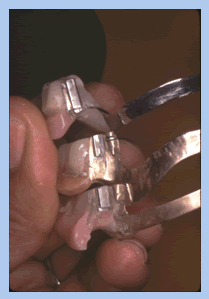 An attachment can be used to rigidly retain a partial a partial denture or passively retain a partial denture. The botttom two partials use lingual arms and springs to rigidly retain the partial. Only the top partial uses a passive attachment. It uses the path of insertion as a retentive mechanism to allow free-moving stress breaking action.
 An attachment can be used to rigidly retain a partial a partial denture or passively retain a partial denture. The botttom two partials use lingual arms and springs to rigidly retain the partial. Only the top partial uses a passive attachment. It uses the path of insertion as a retentive mechanism to allow free-moving stress breaking action.
A free moving passive attachment has several advantages over a rigid attachment:
- Stress breaking action eliminates the destructive “locking” forces to the abutment teeth.
- Physiologic stimulation of the abutment teeth encourages longevity.
- Physiologic stimulation of the edentulous ridges results in firm, healthy tissue and less tendency to resorb
Rigid connectors apply lateral forces to the abutment teeth that are ultimately destructive. Teeth are designed to withstand vertical forces, but they cannot always tolerate forces in other directions. Thomas Forde, in The Principles and Practice of Oral Dynamics 7 theorizes that vertically directed forces drive the hydraulic system of blood supply to the periodontal structures (gum and bone), whereas rocking or rotational forces disrupt the blood supply, causing “force-induced mouth degeneration” and loss of teeth.
In gripping the abutment teeth, a clasp acts as an orthodontic appliance, torquing teeth laterally back and forth until they become loose and require extraction. The usual pattern of clasp cases is the sequential moving of clasps to adjacent teeth as abutments are lost, with a full denture as the eventual outcome.
Read More About:
Precision Attachments Overview
Fixed Restorations are Not Always
Better