WE TREAT YOUR TOTAL ORAL HEALTH
Dealing with one tooth at a time never solves the problem.
An overall approach saves time, money and frequent discomfort.
We correct abnormalities that cause future problems.
We provide thorough, comfortable hygiene visits and periodic exams.
 In order to define successful dentistry, it is important to have a critical definition of health.What is Health? Health has often been defined as the absence of disease. “Far from being simply the absence of disease”, says Dr. Andrew Weil in Health and Healing, “health is a dynamic and harmonious equilibrium of all of the elements and forces making up and surrounding a human being”. Every person is different and almost everyone has a weakness in some aspect of their construction. If that weakness is the oral cavity, optimal oral health may not be attainable. These patients may also enjoy periods of periodontal health and suffer periods of periodontal disease during their lifetimes. The reasons are not always clear. A definition of successful dentistry, therefore, must take into account the patient’s overall health and history.
What is Successful Dentistry
- Longevity: Restorations that last many years in the mouth
- Resistance against decay
- Resistance against Periodontal Bone Loss
- Esthetics, Patient Comfort and Proper Function
- Caring Patient Management during all phases of treatment. Gradual transitions are better than abrupt changes. Patient should be prepared slowly for major restorative changes so they can adapt more easily.
- Success is planning to handle complications that might arise in the future
- Teeth are Preserved to support new dental restorations if replacement becomes necessary. Dentistry may not last a lifetime. The mouth changes and materials wear out. At some point dentistry may need to be replaced to compensate for the changes.
Criteria for Achieving Succesful Dental Restorations
- Correct Diagnosis
- Sound Technique
- Patient Comfort
- Ideal Structural Design
- Neuromuscular Harmony
- Periodontal Health
- Longevity
Successful dental restoration starts with a correct diagnosis of the patient’s existing problems and an analysis of the patient’s health, needs and desires. There are many options for treatment and the treatment plan that is best for the patient must be selected from these options.
The treatment plan must be carried out according to a solid, evidence-based technique that minimizes future trouble. Since disease-causing bacteria are microns long, the weakest link in the chain of the technique is likely to jeopardize a successful outcome. The technique must be executed with patient comfort in mind. A successful outcome of dental restorations also depends on patient comfort and satisfaction, both during and after treatment. Each visit should be an improvement and temporary restorations should be esthetic, comfortable and not fall out. All restorations—temporary and permanent–must be designed according to ideal engineering principles that promote cleansiblity, enhance periodontal health, and function in harmony with the muscles. When there is a questionable prognosis, a successful dentistry includes a contingency plan in the event of trouble. Many patients are reaching financially to have sophisticated dentistry and they should have the benefit of this approach.
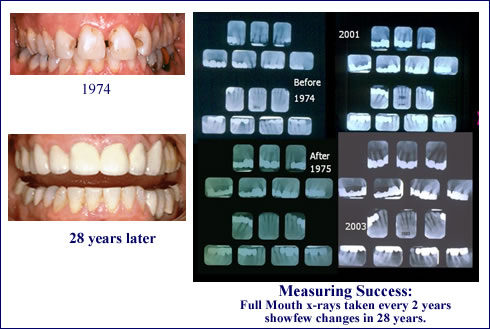
Measuring Success
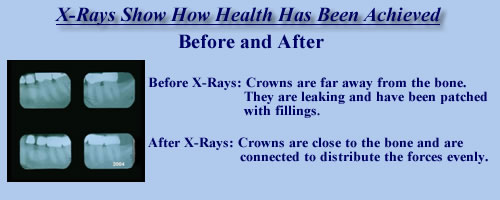
X-Rays are one of the best tools to measure the success of restorative dentistry because it shows the level of the bone around the roots of teeth. The longevity of teeth ultimately depends on the health of this bone. Restorations should be designed so that they relate to the bone. Restorations brought close to the bone follow good principles of engineering in that they bring the forces close to the supporting structures. Success can be determined by comparing bone levels in current X-Rays with bone levels in previous sets of X-Rays. The successful restoration will show minimal changes in the X-Rays over a period of many years. In some individuals dentistry can last 40 years because changes in the bone (and wear of the materials) are minimal. Others may need to replace dentistry after 10 to 15 years in order to compensate for any changes. However, successful dentistry preserves the teeth so that they can support new dental restorations.